


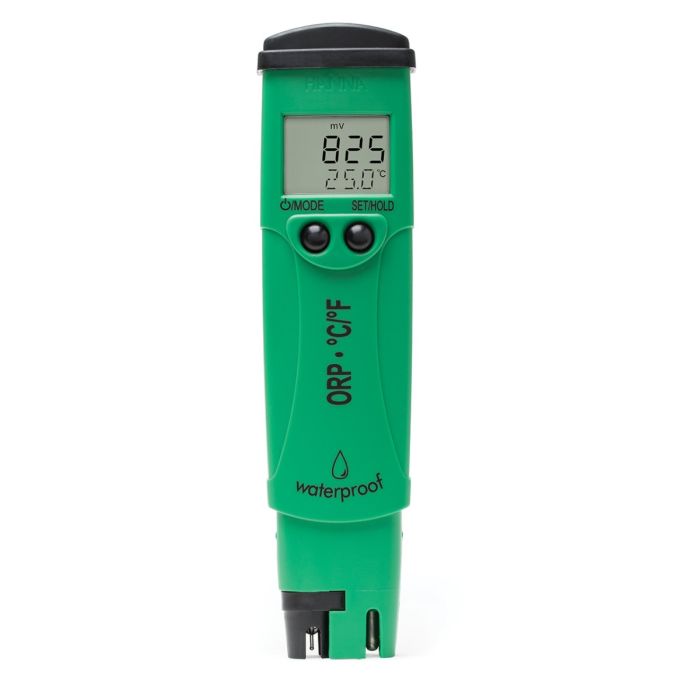

| SKU | HI98120 |
| Name | ORP/Temperature Tester – HI98120 |
| ORP Range | ±1000 mV |
| ORP Resolution | 1 mV |
| ORP Accuracy | ±2 mV |
| Temperature Range | -5.0 to 60.0°C / 23.0 to 140.0°F |
| Temperature Resolution | 0.1°C / 0.1°F |
| Temperature Accuracy | ±0.5°C /±1°F |
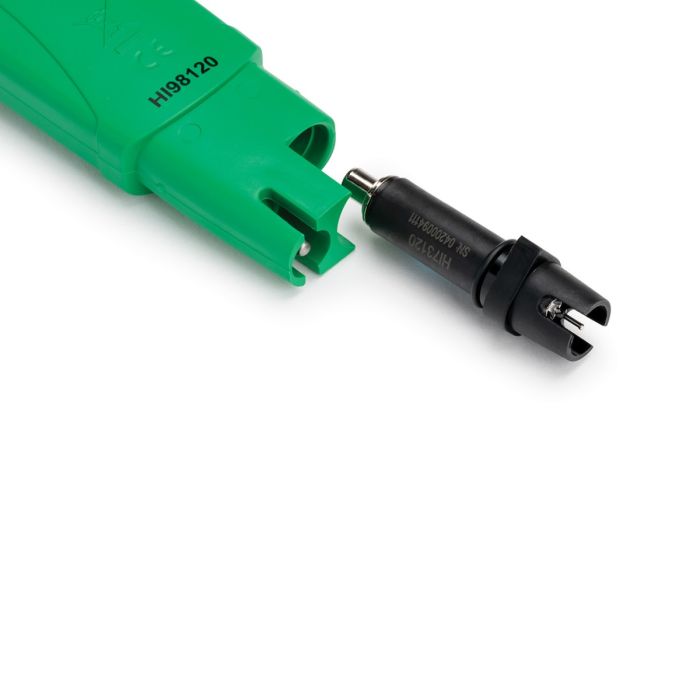
| ORP Electrode | HI73120 replaceable ORP electrode (included) |
| Automatic Shut-Off | after 8 minutes of non-use |
| Battery Type/Life | 1.5V (4) / approx. 300 hours of continuous use |
| Environment | -5 to 50°C (23 to 122°F); RH max 100% |
Similar to a pH measurement that quantifies the how acidic or alkaline solutions are, ORP (Oxidation Reduction Potential) measurements quantify the overall state of a solution as having the ability to oxidize or reduce a chemical species. Oxidizing and reducing reagents are used to participate in chemical reactions known as a redox reaction.
An important part of the ORP probe is to have a sensor that is chemically inert; meaning it cannot be oxidized or reduced itself. It must also have the proper surface characteristics to promote rapid electron exchange, a property known as high exchange current density. Two noble metals have proven to work well for this purpose: pure platinum and pure gold. Both are commonly used in the construction of ORP probes.
The platinum sensor is often preferred because it is mechanically simpler to produce. Platinum can be welded to glass and also has a similiar thermal expansion coefficient. Sensors made of gold cannot be welded to the glass and are often placed in plastic supports applied to the glass or plastic tube by means of tiny elastomeric bungs.
Many industries rely upon ORP measurements including swimming pools, food processing, boilers and cooling towers, and plating. The measurement of ORP helps the user monitor the effectiveness of disinfecting compounds including chlorine and ozone. ORP is also used to monitor redox reactions including the use of bisulfite in the reduction of hexavalent chromium to trivalent chromium in plating wastewater.
